01 / Blending
Train-to-vessel blending
Decide which grades from which mines are combined for each vessel so the cargo meets its contractual quality requirements.
BlendOpt is a configurable optimisation platform for mining value chains. Configured for port blending and day-of-operations scheduling, it tracks what is arriving by train, what is sitting on each port stockpile and what each vessel needs, then works out the blend that meets the contract quality at the highest value.
An increase in the value of some vessel blends, with the blends still meeting the contractual requirements.
Daily data from the mines, the laboratory and the terminal keeps the plan in line with conditions on the ground, so the schedule is still useful at the end of the day it was made.
Decide which grades from which mines are combined for each vessel so the cargo meets its contractual quality requirements.
Monitor stockpile levels and qualities such as ash, volatile matter, sulphur, moisture and NCV using regularly updated data from the terminal.
Show new tippings to each stockpile and flag any tipping outside grade specifications as a quality risk.
Replace trial-and-error blend development with optimisation, including grades that would not normally be considered in a manual blend.
Update the plan with daily train arrival status, laboratory results, inventory reconciliation, vessel berthing and vessel ETA.
Connect the operation’s data sources through a configurable ETL pipeline and give non-technical users live dashboards of port operations.
Results BlendOpt customers have measured in blend value, product quality and revenue across their coal value chains.
What can be loaded onto a vessel depends on what was mined, how it was processed and which trains reached the port.
BlendOpt takes what each mine supplies as an input and models stockpiles, logistics and sales contracts together, so a blend decision at the port is valued by its effect on the whole operation. See how this works for coal blending, multi-mine optimisation, stockpile optimisation and integrated mine planning and scheduling.
Each vessel is loaded to its contract quality at the best available value, using the day’s train, laboratory, inventory and vessel data.
A multi-mine South African coal exporter used BlendOpt as its day-of-operations system to track port inventory and optimise the blending of coal onto vessels.
Blends were developed manually, so high discount grades that could add value were not normally considered.
The challenge, solution and value unlocked for a South African coal exporter’s port operations, as a PDF.
A multi-mine coal exporter in South Africa needed a “Day of Operations” system to track port inventory and optimise the delivery of coal onto vessels. Making informed and accurate decisions required daily live data updates of train arrival status, coal quality lab results, inventory reconciliation, vessel berthing and vessel ETA.
Coal transport consisted of railing multiple grades from each of several mines, with tracking and management of coal qualities including ash, volatile matter, sulphur, moisture and NCV.
Using BlendOpt, the client was able to monitor stockpile levels and qualities using regularly updated data from the coal terminal, with the predicted qualities falling within 0.6% of the vessel COA.
The port management team could view new tippings to the stockpiles, with validation showing when tipping qualities were outside grade specifications and therefore presented a quality risk. BlendOpt’s built-in optimisation module also removed the need for trial-and-error blend development.
BlendOpt’s highly configurable ETL pipeline GUI was used to rapidly configure and integrate the client’s data sources within the application.
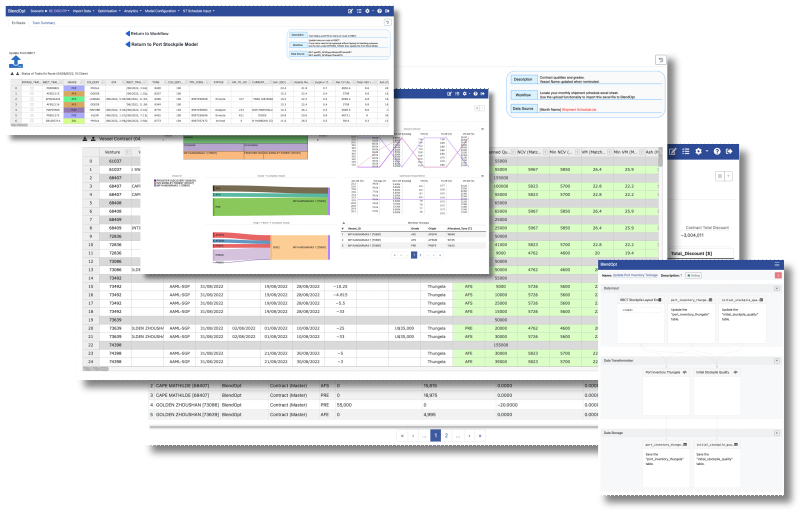
By selecting high discount grades to add to the blend, which would not normally be considered during manual blend development, BlendOpt found a solution that let the client increase the value of some of its blends by over 30%, with the blends still meeting the contractual requirements.
BlendOpt brought transparency and confidence to daily decisions with a significant impact on the client’s cash flow, while data integration and live dashboards allowed non-technical users to rely on BlendOpt as a single source of truth for viewing and understanding the client’s port operations.
How BlendOpt tracks port inventory and optimises the blend loaded onto each vessel.
Day-of-operations scheduling is the short-term planning of what coal or ore is stacked, blended and loaded at the port, updated as the day’s information arrives. It uses train arrival status, laboratory quality results, inventory reconciliation, vessel berthing and vessel ETA to keep the plan current. The aim is to load each vessel to its contract specification at the best available value.
BlendOpt searches every feasible combination of available grades rather than relying on trial and error. In one case study it selected high discount grades that would not normally be considered during manual blend development. The coal exporter increased the value of some of its blends by over 30%, with the blends still meeting the contractual requirements.
In the South African coal export case study, BlendOpt tracked stockpile levels and qualities using regularly updated data from the coal terminal. The predicted qualities fell within 0.6% of the vessel certificate of analysis (COA). That level of accuracy gave the port team confidence to rely on the predicted qualities when making daily blending decisions.
Typical inputs are train arrival status, coal quality laboratory results, stockpile inventory, vessel berthing and vessel ETA, along with the contract quality requirements for each vessel. BlendOpt’s configurable ETL pipeline GUI is used to connect and configure these data sources within the application. Qualities tracked can include ash, volatile matter, sulphur, moisture and NCV.
Port management teams use BlendOpt to see new tippings to stockpiles and to be warned when a tipping is outside grade specifications. Live dashboards let non-technical users rely on BlendOpt as a single source of truth for viewing and understanding port operations. Planners use the optimisation module to develop blends that meet contract requirements.
Bring us the problem. We’ll show you what BlendOpt finds when the whole value chain is optimised together.
Tell us about the decision you are trying to make. We will show you how BlendOpt models it, whether you license the platform, commission a study, or have our specialists run it for you.